


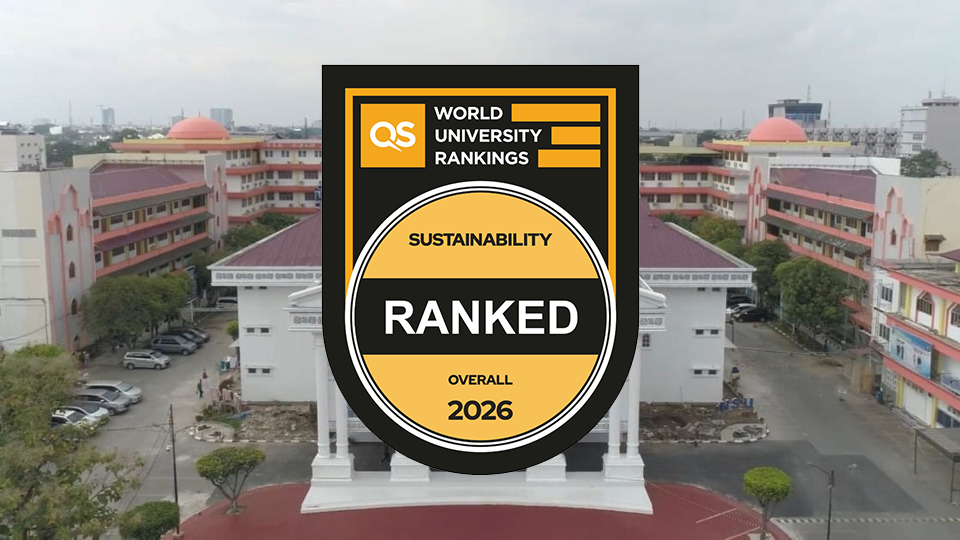
Universitas Muhammadiyah Sumatera Utara (UMSU) has been listed in the QS World University Rankings (WUR) Sustainability 2026, officially released by Quacquarelli Symonds (QS) on Tuesday, November 18, 2025. This ranking assesses universities’ contributions to sustainability across three main categories: social, environmental, and governance. In this year’s edition, QS included 2,001 universities worldwide in its rankings.
UMSU is ranked 12th in Indonesia in the Social Impact category, positioned 415th in Asia, and placed in the 1251+ global band. This category reflects the extent to which universities benefit society through education, health, equality, knowledge collaboration, and employment opportunities for students and alumni.
In the ranking results, UMSU demonstrated notable strengths in two key indicators. First, Health & Wellbeing, where UMSU ranked 1st nationally, highlighting the university’s strong role in community health programs, student activities, and research related to social welfare. Second, the Impact of Education indicator placed UMSU 2nd nationally, reflecting the quality of learning, curriculum relevance, and the contribution of education to broader society.
In addition to UMSU, several other universities within the Muhammadiyah Higher Education network were also included in this year’s QS Sustainability rankings, including Universitas Muhammadiyah Yogyakarta (UMY), Universitas Muhammadiyah Surakarta (UMS), and Universitas Ahmad Dahlan (UAD).
UMSU Rector Prof. Dr. Agussani, MAP, stated that this achievement continues UMSU’s performance in regional and global rankings. He noted that UMSU’s inclusion in QS Sustainability demonstrates the university’s consistency in building impactful contributions to society. “This complements our achievement in the QS Asia Rankings. UMSU has consistently developed as an impact-oriented university through the roles of students, research outputs, creative works, and community service. This recognition shows that the steps taken by the university have meaning at the international level,” he said.
He added that UMSU will continue to strengthen its sustainability agenda through applied research, innovative learning, national and international collaborations, as well as empowerment programs carried out by students and faculty members. According to him, this ranking provides a foundation to expand sustainability initiatives in the coming years, including improving institutional data quality, strengthening environmental activities, and enhancing governance aspects.
As a ranking that integrates the dimensions of education, research, community engagement, and governance, QS Sustainability 2026 offers a comprehensive picture of universities’ contributions to global sustainability. Its assessment methodology covers three major categories—Environmental Impact, Social Impact, and Governance—with indicators such as environmental education, sustainability research, public health, education quality, equality, knowledge exchange, employment opportunities, and institutional transparency. All indicators are calculated using a combination of research data, institutional data, reputation surveys, alumni outcomes, and national statistics.


