


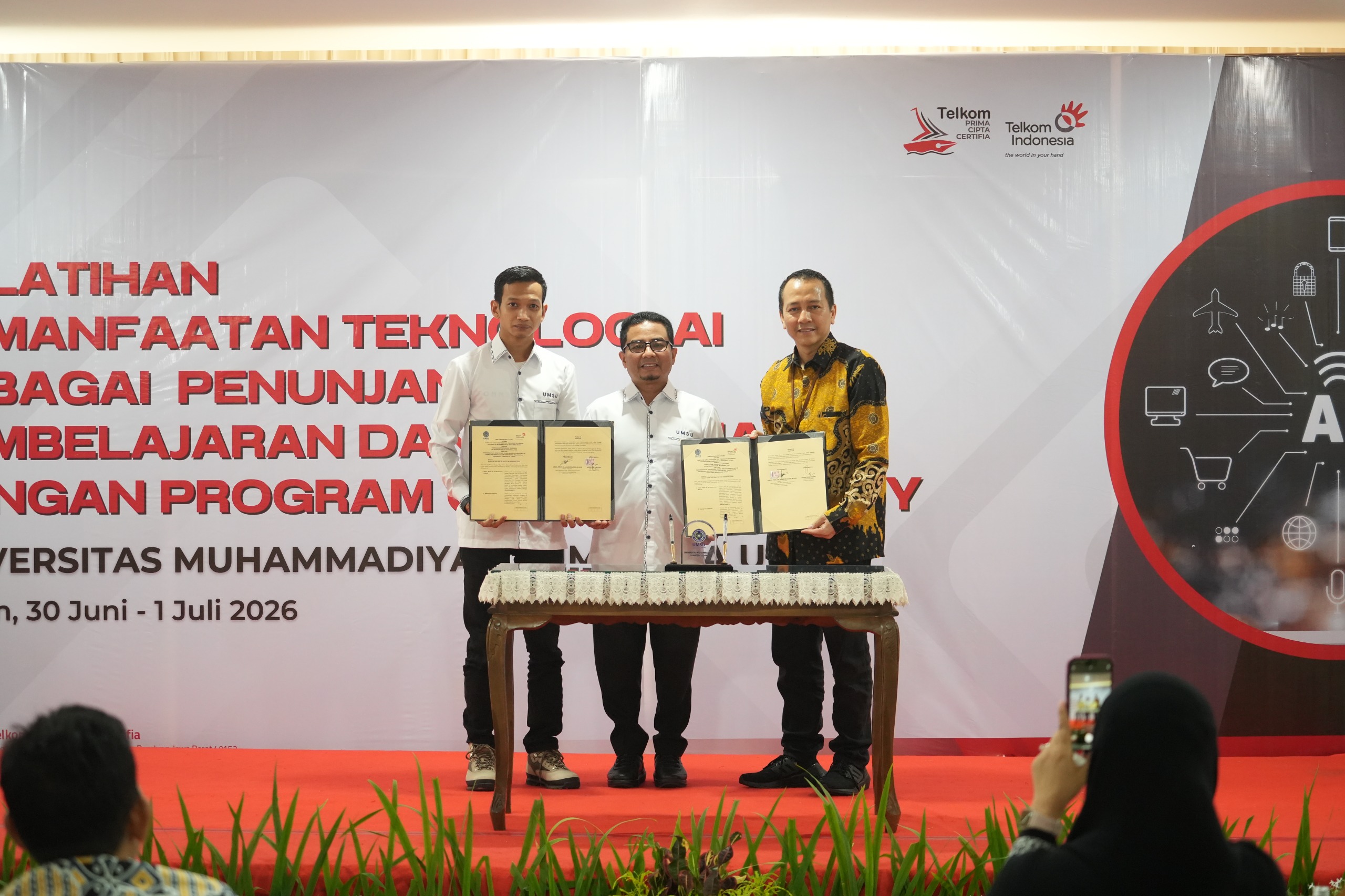
Universitas Muhammadiyah Sumatera Utara (UMSU), in collaboration with Telkom Indonesia, organized the AI Gemini Academy training program to promote the effective use of artificial intelligence in supporting the Three Pillars of Higher Education (Tri Dharma Perguruan Tinggi)—education, research, and community engagement. The two-day program was held from June 30 to July 1 at the Faculty of Computer Science and Information Technology (FIKTI) Hall, 7th Floor, UMSU Campus, Jalan Muchtar Basri No. 3, Medan.
 The training was officially opened by UMSU Rector Prof. Dr. Akrim, M.Pd., and attended by Agung Tricahyono, General Manager of Telkom Witel North Sumatra; Kristiyanto, S.H., M.PP., Customer Success Manager for Google for Education; Gede Jiwo Wirasmoro, Websis Manager and keynote trainer; faculty leaders, bureau heads, and lecturers from across the university.
In his opening remarks, the Rector emphasized the importance of adapting to technological advancements, particularly generative artificial intelligence such as Google Gemini. He noted that AI can help universities formulate more adaptive and forward-looking policies in response to rapid technological change.
“This technology broadens our perspective in developing adaptive institutional policies. As educators, lecturers must be able to evolve alongside technological progress,” he said.
The Rector also reaffirmed UMSU’s commitment to continuous digital transformation, emphasizing that the quality of graduates depends greatly on the quality of their lecturers.
“Outstanding graduates are shaped by outstanding lecturers. That is why we must embrace a more flexible mindset and remain open to change,” he stated.
Concluding his remarks, Prof. Akrim encouraged the entire academic community to seize this opportunity to prepare for future challenges.
“Let us make the most of this opportunity to equip ourselves for the future. We should never become complacent with our current achievements. UMSU is committed to strengthening its collaboration with Telkom, and we hope this partnership will continue to grow,” he said.

Earlier, Agung Tricahyono, General Manager of Telkom Witel North Sumatra, expressed his appreciation for the close partnership that has been established between Telkom and UMSU. He expressed hope that the training would deliver long-term benefits for the higher education sector.
He emphasized that artificial intelligence is not intended to replace educators but to enhance the quality of teaching and learning.
“In higher education, AI is not meant to replace us. Instead, it serves as a powerful tool to support educators by helping them develop learning materials, create examination questions, and fulfill various academic responsibilities,” he explained.
Meanwhile, Kristiyanto, S.H., M.PP., Customer Success Manager for Google for Education, noted that UMSU is the first university on the island of Sumatra to receive this training program in collaboration with Google.
“UMSU has achieved an important milestone by becoming the first university in Sumatra to host this training. We hope this is only the beginning and that more collaborative training programs will follow,” he said.
He also encouraged lecturers to integrate Google Gemini into their daily activities as educators and researchers.

“We hope lecturers will learn to use Gemini effectively in their daily work—as teachers, educators, and researchers,” he added.
According to Kristiyanto, the primary objective of the training is to raise awareness among academics about the ethical and responsible use of artificial intelligence within higher education.
“We want lecturers to become more aware of how to use AI ethically and responsibly while upholding academic integrity. We hope this program will be both successful and impactful,” he concluded.
As part of the event, Telkom Indonesia and Universitas Muhammadiyah Sumatera Utara signed a Memorandum of Understanding (MoU), followed by the signing of a Memorandum of Agreement (MoA) between Telkom and the Faculty of Computer Science and Information Technology (FIKTI) UMSU. These agreements further strengthen the strategic partnership between the two institutions in advancing education, innovation, and digital transformation.


