


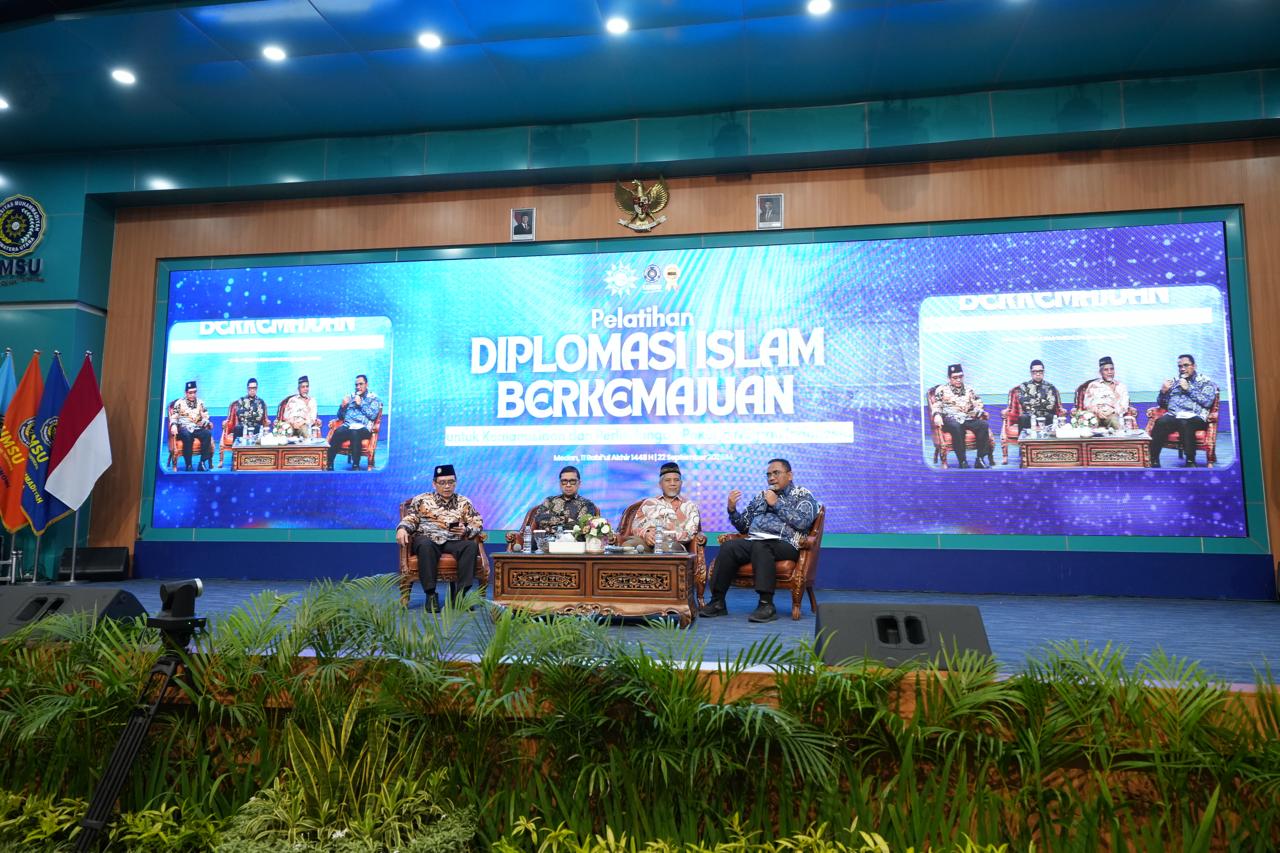
The International Relations and Cooperation Institute (LHKI) of Muhammadiyah’s Central Board and Universitas Muhammadiyah Sumatera Utara (UMSU) held a three-day Progressive Islamic Diplomacy Training from Tuesday to Thursday (September 22–24) at the university’s auditorium on Jalan Kapten Muchtar Basri No. 3, Medan.
 The opening session featured a pre-49th Muhammadiyah and Aisyiyah Congress dialogue titled “Humanitarian Diplomacy and the Protection of Indonesian Migrant Workers: Government and Parliamentary Perspectives.” Muhammadiyah Central Board Chair Prof. Dr. Syafiq Mughni, M.A., delivered the keynote presentation, titled “The Internationalization of Muhammadiyah and Progressive Islam.”
The subsequent public lecture, moderated by Dbs. Bunyan Saptomo, featured Deputy Chief of Mission at the Indonesian Embassy in Malaysia Danang Waskito; Deputy Chair of the Indonesian House of Representatives’ Legislative Body, Dr. Ahmad Doli Kurnia Tandjung; and Regional Representative Council (DPD RI) member K.H. Muhammad Nuh, M.S.P.
The training speakers included Prof. Dr. Din Syamsuddin, Dr. Imam Addaruqutni, Prof. Dr. Muhammad Qorib, M.A., Dbs. Bunyan Saptomo, Agung R. Hidayat, S.H., M.H., Dra. Yayah Khisbiyah, M.A., and Subhan Setowara, M.A.
In his remarks, UMSU Rector Prof. Dr. Akrim, M.Pd., said the initiative opens opportunities for the university to expand its role in preparing Indonesian migrant workers (PMI) for employment abroad. UMSU plans to provide training for prospective workers before their departure.
He explained that universities have significant potential to help prepare a skilled workforce, including by developing language proficiency and job-specific skills tailored to the needs of destination countries.
“We may establish a training center at UMSU to prepare workers before they go abroad. We can collaborate with LHKI to facilitate this,” Prof. Akrim said.
UMSU hopes to play a greater role in facilitating the placement of Indonesian workers overseas through cooperation with the government and LHKI of Muhammadiyah’s Central Board.
“If permitted, UMSU would like to become one of the institutions facilitating the placement of Indonesian workers abroad. We hope to make this a reality,” he added.
According to Prof. Akrim, the opportunity is promising, as companies from Malaysia have already approached UMSU to recruit workers, particularly for the food and beverage sector and healthcare industry.
He said UMSU had recently assisted Malaysian company Hasani Group in recruiting 17 workers from Medan.
“Companies from Malaysia have consistently approached UMSU for workers. We have begun identifying candidates, particularly for the food and beverage sector, including restaurants, as well as healthcare,” he said.
The rector noted that opportunities for placing Indonesian migrant workers extend beyond Malaysia to other countries. UMSU plans to leverage its existing resources, including its programs in medicine, nursing, pharmacy, and midwifery.

He identified communication and language proficiency as key challenges, particularly for workers seeking employment in the Middle East and Europe.
“UMSU has a responsibility to prepare workers who are job-ready, particularly in terms of language skills,” Prof. Akrim said.
UMSU has strengthened its language center, which is expected to provide training for prospective migrant workers. This preparation aims to equip them not only with professional skills but also with the communication abilities required in their destination countries.
Prof. Akrim also emphasized that preparing migrant workers must go hand in hand with ensuring their protection. He called for collaboration among the government, Muhammadiyah, universities, and local communities to ensure Indonesian workers receive better preparation and protection before going abroad.
“The government has policies and authority, Muhammadiyah has its movement and networks, universities contribute resources and knowledge, and communities bring practical experience. This is why collaboration is essential,” he stressed.
Over the past three years, UMSU has conducted community service programs in Malaysia, including educational support for children of Indonesian migrant workers through approximately 50 community learning centers. The programs have been carried out in collaboration with the Special Branch of Muhammadiyah in Malaysia (PCIM Malaysia).
The rector said this experience could further strengthen UMSU’s contribution to migrant worker issues while expanding Muhammadiyah’s international network.
Meanwhile, Muhammadiyah Central Board Chair Prof. Dr. Syafiq Mughni, M.A., discussed the development of Muhammadiyah in his presentation, “The Internationalization of Muhammadiyah and Progressive Islam.” He explained that Muhammadiyah is no longer confined to Indonesia but has developed into an international organization with networks and partners in various countries.
“Today, the world clearly demands that Muhammadiyah establish a presence on the international stage. We must not remain an organization on the margins of the world; we must be part of the global mainstream,” Prof. Syafiq said.
He noted that Muhammadiyah currently has Special Branches (PCIM) in approximately 30 countries, playing an important role in expanding the organization’s activities overseas.
In addition to its international branches, Muhammadiyah has sister organizations in several countries. These organizations share similar visions and missions in religious outreach, education, and social services, while operating as independent legal entities under the laws of their respective countries.
These networks are increasingly important to Muhammadiyah’s internationalization efforts. The organization also continues to build partnerships with external institutions that share similar goals.
Prof. Syafiq said growing international interest in Muhammadiyah reflects its expanding reputation. People and institutions outside the organization are increasingly seeking to learn about its organizational management and models of Islamic education.
He called on all elements of Muhammadiyah to unite and work together to fulfill this role. The diplomacy training at UMSU, he said, represents an effort to strengthen Muhammadiyah cadres’ capacity to carry out humanitarian responsibilities and build international networks.
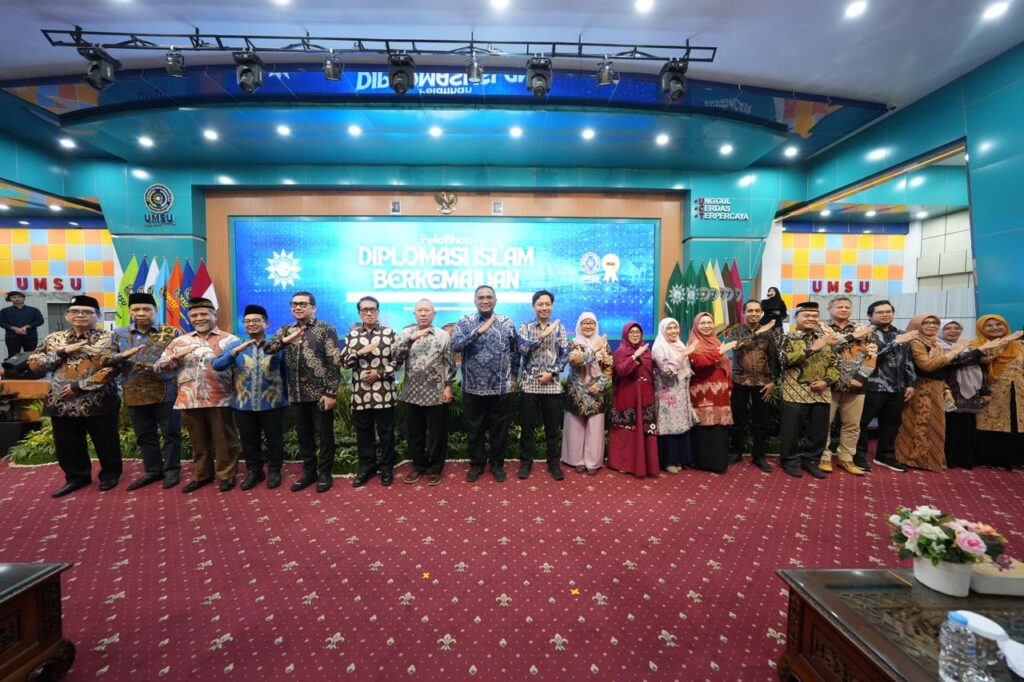
Attendees at the opening included Education and Culture Attaché at the Indonesian Embassy in Kuala Lumpur Ir. R. Ahmad Romadhoni Surya Putra, S.Pt., M.Sc., Ph.D.; LHKI Muhammadiyah Central Board Chair Dr. Imam Addaruqutni, M.A.; LHKI Secretary Dra. Yayah Khisbiyah, M.A.; Treasurer Puti Hasanatu Syadiah, M.I.Kom.; Chair of UMSU’s Board of Trustees Prof. Dr. Agussani, M.AP.; Vice Rector for Resources and Finance Prof. Dr. Muhammad Qorib, M.A.; Vice Rector for Research, Innovation, Community Service, and Internationalization Dr. Rudianto, M.Si.; and faculty leaders from across UMSU.


