


Observation of “Super Blood Moon” at OIF UMSU is Constrained by Weather
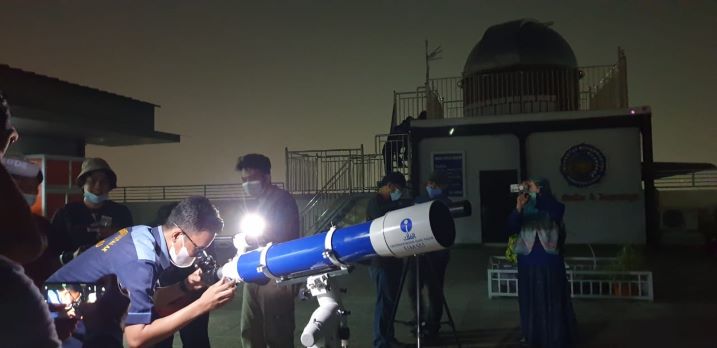
Observing the blood moon eclipse (super blood moon) held at the Falak Science Observatory of Universitas Muhammadiyah Sumatera Utara was constrained by cloudy weather, so that the eclipse sighting could have been more optimal.
“The slightly cloudy weather conditions resulted in the eclipse sighting, which was a special moment not maximized because clouds partially covered it. It was only in the final phase that the weather looked bright so that the eclipse moment could be enjoyed, even directly without the help of a telescope,” said the Head of OIF UMSU, Dr. Arwin Juli Rahmadi Butarbutar, to reporters on the sidelines of observation activities, Wednesday night (5/26).
He explained that the moment of the eclipse of the super blood moon or super blood moon is a unique phenomenon. The most striking feature of the total lunar eclipse this time is its color, called the super blood moon”—visibility conditions on Earth cause this blood moon phenomenon. As the Moon passes through the Earth’s shadow, less sunlight falls on its surface and gets darker.
The red color of the Moon itself is due in part to the Earth’s atmosphere. Large cloud formations on Earth can also explain the difference in brightness. The cloud effect appears as dark patches across the Moon’s obscured surface.
He further explained that, in contrast to the previous eclipse moment, this time, OIF UMSU held limited lunar eclipse observations due to the COVID-19 pandemic situation. Eclipse observation begins with maghrib prayer followed by eclipse prayer by implementing health protocols.
For eclipse observations, OIF UMSU provides several telescopes that are used by the public, which, for this time, the number is limited.
According to Arwin, the eclipse moment for the Medan City area can only be seen around 50 percent. The lunar eclipse began to appear after sunset and ended around 19.52 WIB.


