


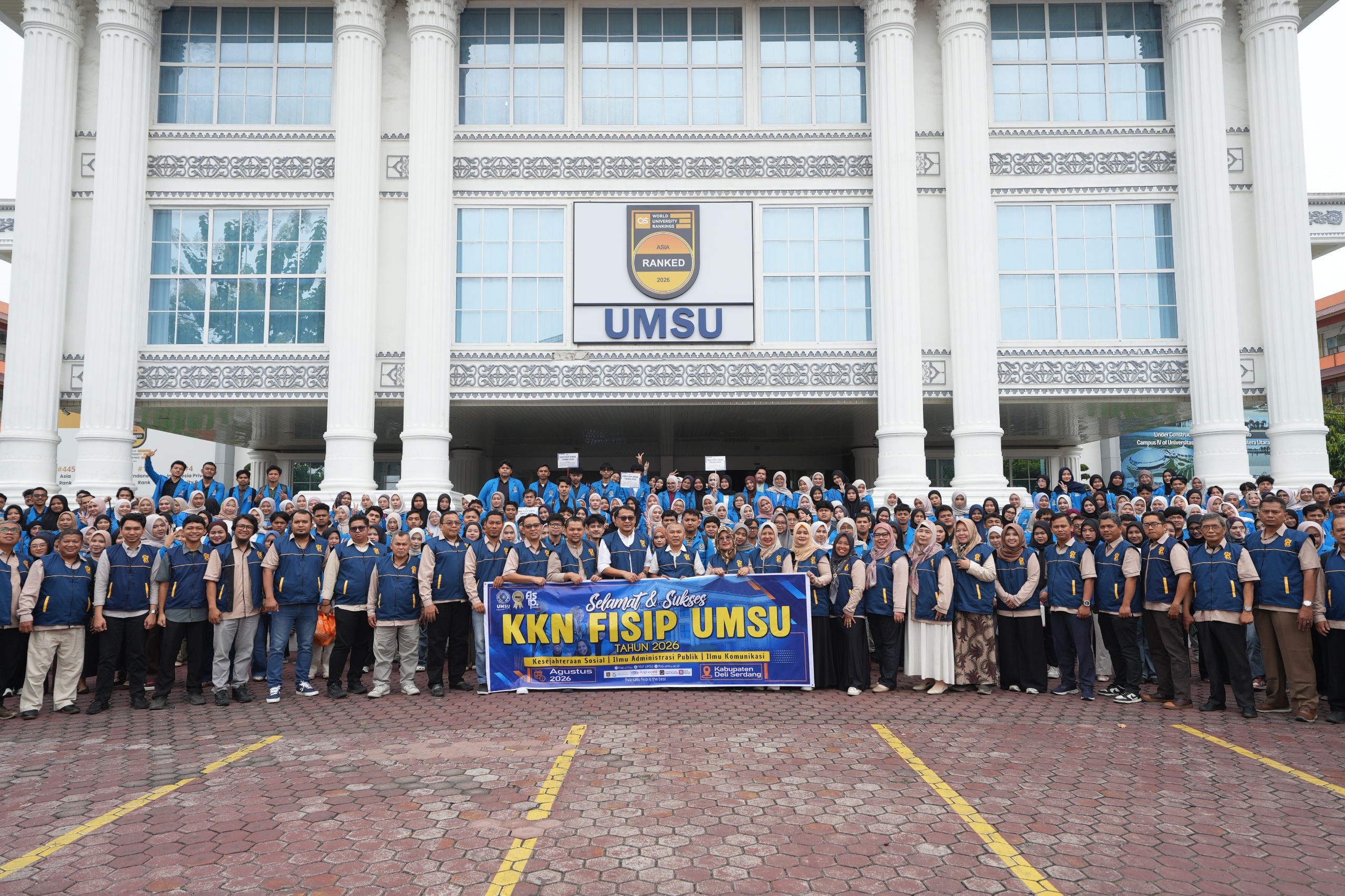
The Community Service Program (KKN) began with a send-off ceremony led by the Rector of Universitas Muhammadiyah Sumatera Utara (UMSU), represented by Vice Rector for Research, Innovation, Community Service, and Internationalization (RIPI), Dr. Rudianto, M.Si., at the Auditorium on the UMSU campus, Jalan Muchtar Basri No. 3, Medan, on Tuesday (18/8).
 The participants were divided into three groups. A total of 312 students joined the Regular KKN and were assigned to 31 villages across various subdistricts in Deli Serdang Regency. Meanwhile, 56 students participated in the International KKN in Kuala Lumpur, Malaysia, while another 36 students received KKN recognition for having previously carried out community service and other related activities.
In his remarks, Vice Rector for RIPI, Dr. Rudianto, S.Sos., M.Si., highlighted several essential skills that students need to prepare for their future careers. He explained that the KKN program provides students with an opportunity to gain practical experience and develop their skills while engaging directly with communities.
“As prospective university graduates, communication skills are among the most important competencies. The ability to communicate is essential in determining how effectively we can build communication with village officials and local communities,” he said.
Dr. Rudianto also emphasized the importance of building networks and developing the ability to connect with people, so that students can establish meaningful relationships not only in the digital world but also within society.
“Do not leave UMSU without acquiring new skills. When you graduate and become an alumnus of UMSU, you should have new skills so that when you hold a UMSU degree, you can stand out among graduates of other universities,” he advised.
According to the Vice Rector for RIPI, KKN is an important opportunity for students to gain first-hand experience in the community while building professional and social networks. He also highlighted the importance of international experience as part of students’ capacity development amid increasingly globalized opportunities and challenges.
Earlier, Dean of FISIP, Dr. Arifin, explained that students must go through three stages of the KKN program. The first is preparation, which includes socialization, determining locations and field supervisors (DPL), and developing activity programs. The second is the field implementation stage, in which students directly engage at their assigned locations, continuing through the end of August. The third is the preparation of KKN reports, consisting of written reports and videos documenting the implementation, which must be uploaded to their respective social media accounts.
The Dean noted that the experience students gain during KKN and internships can be developed into research ideas for completing their studies.
“What you learn and experience during KKN and internships can also become a potential thesis topic for completing your studies,” he said.

To ensure that the KKN program runs effectively, field supervisors are required to visit their assigned locations at least once after the program begins.
The event was also attended by Vice Dean I Dr. Abrar Adhani, S.Sos., M.I.Kom.; Vice Dean III Dr. H. Yurisna Tanjung, S.Sos., M.AP.; and FISIP UMSU program leaders, including Head and Secretary of the Communication Studies Program, Dr. Akhyar Anshori, S.Sos., M.I.Kom., and Dr. Faizal Hamzah Lubis, S.Sos., M.I.Kom.; Head of the Social Welfare Study Program, Dr. Sahran Saputra, S.Sos., M.Sos.; as well as Head and Secretary of the Public Administration Study Program, Ananda Mahardika, S.Sos., M.SP., and Dr. Jehan Ridho Izhar Syah. The event was also attended by the field supervisors (DPL) who will accompany and guide students throughout the KKN program.


