


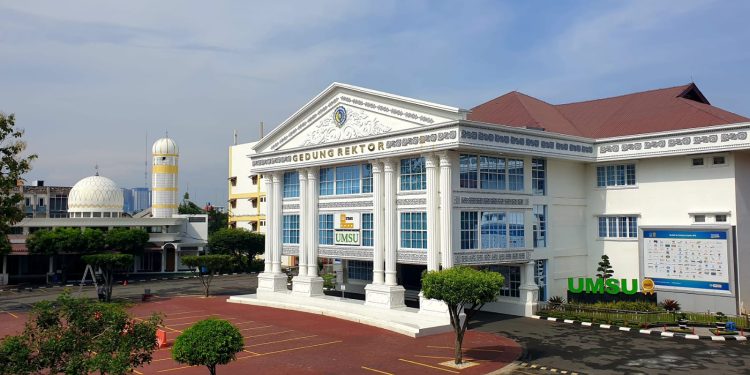
Universitas Muhammadiyah Sumatera Utara successfully added three “A” accredited study programs to superior: Management, Social Welfare Science, and Sharia Business Management.
Until April 2023, nine study programs have been accredited superior in addition to the last three study programs: Medical Education Study Program, Professional Doctor Study Program, Islamic Education, Indonesian Language Education, Accounting Education, and Communication Science Study Program. “Alhamdulillah, this achievement is certainly an achievement and the result of the joint work of the entire academic community,” said UMSU’s Rector, Prof. Dr. Agussani, MAP in Medan, Saturday (6/5).
UMSU is currently the only private university in Sumatra with superior accreditation. In addition, it also has the highest number of Superior accredited study programs for Private Universities in the North Sumatra region. Besides that, there are also nine “A” accredited study programs.
The UMSU’s Rector expects that the various achievements and achievements achieved will not make him complacent. UMSU must continue to improve the quality of education and academic services because the challenges ahead will be even more severe.
UMSU has won three times in a row the general champion of the best private universities in the Higher Education Service Institution (LLDikti) Region I North Sumatra (North Sumatra). In addition, UMSU also won four stars from the international ranking agency QS Stars and received recognition from Malaysia’s Accreditation Agency (MQA).
It’s worth noting that receiving accreditation from the National Accreditation Board of Higher Education, which falls under the Ministry of Education and Culture, can be challenging. Not all colleges or universities in North Sumatra have superior accreditation or the best ranking following the mandate of the Regulation of the Minister of Education and Culture of the Republic of Indonesia Number 5 of 2020 concerning Accreditation of Study Programs and Higher Education.
There are at least two main objectives of accreditation of higher education: determining the feasibility of higher education based on criteria that refer to the National Higher Education Standards—furthermore, ensuring the quality of higher education externally in both academic and non-academic fields to protect the interests of students and society.
Accredited universities have generally met several indicators, such as the number of new students in the last five years, the adequacy of the number of permanent lecturers, to the percentage of on-time graduation and study success.
The National Accreditation Board (BAN) of Higher Education monitors the fulfillment of this accreditation rating requirement at least once every five years and, at the latest, a year before the accreditation period ends.
The Accreditation Instrument based on IAPS 4.0 uses nine criteria as follows:
Vision, Mission, Goals and Strategies, Governance, Governance and Cooperation, Students, Human Resources, Finance, Facilities and Infrastructure, Education, Research, Community Service, Tridharma Outputs and Achievements.
The community must be more critical in choosing universities to continue their education. Superior accreditation of higher education can be a reference to see the performance of the selected university.


