Arabic
ID
Universitas Muhammadiyah Sumatera Utara
  • Home
  • Profile
    • History of UMSU
    • The Philosophy
    • Organizational Structure
    • Vision and Mission
    • Meaning of the Symbol
    • Accreditation
    • The Board of Executive
    • Faculty Profile
    • The Daily Board of Trustees
    • Central Board of Institutions and Units
      • Board
        • Board of Al-Islam and Kemuhammadiyahan
        • Board of Quality Assurance
      • Center
        • Student’s Research and Creativity Center
        • Career Development and Alumni Centre
        • Gender and Child Study Center
        • Center for Entrepreneurship, Innovation and Business
        • Language Center
        • Intellectual Property Management Center
        • Astronomy Observatory
      • Institution
        • Office of International Affairs and Cooperation
        • Research And Community Service Institution
      • Bureau
        • Data and Academic Administration Bureau
        • Students and Alumni Bureau
        • General Administration Bureau
        • Financial Administration Bureau
        • Public Relations Bureau
        • Information Technology System Bureau
      • Units
        • Digital Library
    • Our Facilities
  • Digital Service
    • E-Learning
    • Students Portal
    • Digital Library
    • Staff Information System
    • KKN Online
    • Mail Management Application
    • Assets Information Management System
    • Financial Information System
    • Filing Application
  • Academic
  • News
    • Across Faculties
    • International
    • MBKM
  • Research
  • Repository
  • Journal
  • Admission
No Result
View All Result
  • Home
  • Profile
    • History of UMSU
    • The Philosophy
    • Organizational Structure
    • Vision and Mission
    • Meaning of the Symbol
    • Accreditation
    • The Board of Executive
    • Faculty Profile
    • The Daily Board of Trustees
    • Central Board of Institutions and Units
      • Board
        • Board of Al-Islam and Kemuhammadiyahan
        • Board of Quality Assurance
      • Center
        • Student’s Research and Creativity Center
        • Career Development and Alumni Centre
        • Gender and Child Study Center
        • Center for Entrepreneurship, Innovation and Business
        • Language Center
        • Intellectual Property Management Center
        • Astronomy Observatory
      • Institution
        • Office of International Affairs and Cooperation
        • Research And Community Service Institution
      • Bureau
        • Data and Academic Administration Bureau
        • Students and Alumni Bureau
        • General Administration Bureau
        • Financial Administration Bureau
        • Public Relations Bureau
        • Information Technology System Bureau
      • Units
        • Digital Library
    • Our Facilities
  • Digital Service
    • E-Learning
    • Students Portal
    • Digital Library
    • Staff Information System
    • KKN Online
    • Mail Management Application
    • Assets Information Management System
    • Financial Information System
    • Filing Application
  • Academic
  • News
    • Across Faculties
    • International
    • MBKM
  • Research
  • Repository
  • Journal
  • Admission
No Result
View All Result
Universitas Muhammadiyah Sumatera Utara
Arabic
ID

The Explaination of Archimedes’ Law

Fai by Fai
3 years ago
in Opini
0
Hukum Archimedes

Hukum Archimedes

0
SHARES
9.5k
VIEWS
Share on FacebookShare on Twitter

Archimedes’ law

Understanding Archimedes’ Law is a law regarding the principle of buoyancy above liquids. Archimedes’ law is a law that states that any object that is wholly or partially submerged in a liquid, or some liquid, has an upward thrust on the object, or what is often called a buoyant force.

The magnitude of the thrust generated is equal to the weight of the liquid or liquid displaced by the object.

Archimedes’ law states that an object completely or partially immersed in a liquid will experience an upward force equal to the weight of the liquid displaced by the object.

History

Archimedes was a scientist, philosopher, and engineer who lived in Italy when the ancient Greeks came to power in the 2nd century BC. That said, to find out this principle, the king ordered Archimedes to find out whether the crown was the original precious metal on the condition that it did not damage it. Crown.

In short, Archimedes thought a lot about the king’s orders. Finally, he found the answer while taking a bath, seeing that when the body enters the water, some water flows out.

There he got an idea and immediately shouted, “Eureka!” or I found it and left the house empty. This idea became known as Archimedes’ law, which states that the weight of a displaced fluid is equal to the buoyant force acting on the object.

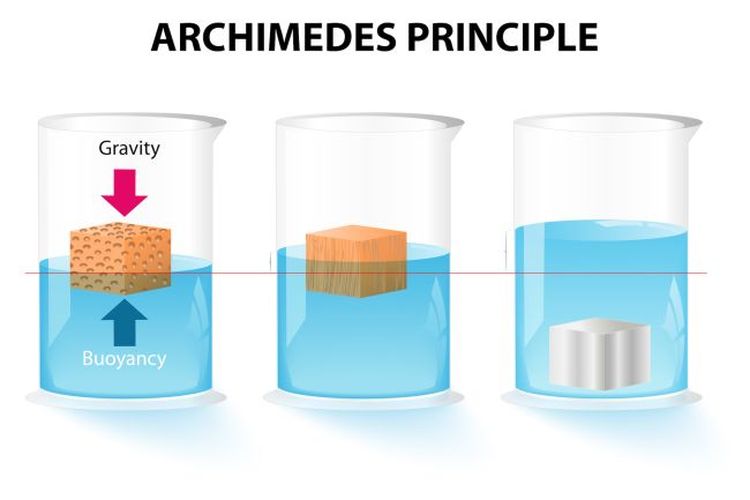
According to Utami et al., 2014, three things can happen when an object is immersed in a liquid. First, this means that objects can float, which is a situation where the density of the fluid is greater than the object’s density.

Then it can also float, which is a condition if the object’s density is the same as the density of the liquid. Finally, it can also sink, where an object’s density is more significant than a liquid’s density.

Archimedes’ law reads, “An object partially or completely immersed in liquid experiences an upward force equal to the weight of the liquid displaced by the object.”

When an object is immersed in a liquid, there are three possibilities: it sinks, floats, and floats.

1. Sinking objects

An object is said to be submerged in a liquid if the position of the object is always
below where the liquid is.

W = the object’s weight
Fa = Archimedes’ force
N = normal force of the plane
In a balanced state, W = N + Fa so that:
W > Fa
m . g > ρZC. Vb. g
ρb. Vb. g > ρZC. Vb. g
ρb > ρZC
ρb = density of the object
ρZC = density of liquid

2. Floating Objects

An object floats in a liquid if the position of the object is below the surface of the liquid and above the base where the liquid is located.

In a floating state, there are two forces: Fa and W. In a balanced state, W = Fa
ρb. Vb. g = ρZC. Vb. g
ρb = ρZC

3. Floating objects

An object floats in a liquid if the location of the object is partly on the surface of the liquid and partly submerged in the liquid.
In a state of floating objects, there are two forces: Fa and W. In a state of balance, then:

W = Fa

Ph. Vb. g = pZC. V2.g

Pb. Vb = Pzc – V₂

because Vb> V2 then: pь<pZC

Application of Archimedes’ Law
Boat

When building ships, one follows Archimedes’ principle that most of the ship is left hollow inside, which keeps its density lower than that of water so that the ship’s weight becomes less than the weight and buoyancy of the water it displaces. As a result, the amount of water displaced affects the ship and floats on the water’s surface.

Fish

Archimedes’ principle also applies to fish swimming in water. Most fish have a swim bladder which helps them control the buoyant force acting on them. A fish fills its swim bladder with air to rise to the water’s surface because its volume increases and more water is displaced, so its buoyancy also increases. In order to dive into the water, the fish releases air from the swim bladder, which reduces its volume, and the buoyant force acting on it also decreases.

Lactometer

Lactometers also work on Archimedes’ principle because adulteration causes changes in density that can be easily identified using this device.

Submarine

Submarines can sink in water and float on the surface of the water, maintaining the water’s density and the submarine’s displacement. The density is maintained by two essential components of the submarine: pressure vessels and ballast tanks.

When we fill the ballast tanks with water, the submarine’s density will be greater than the density of the displaced water, so the submarine sinks into the water, while this water is expelled from the ballast tanks, then ballast. In the tank, the average density of the submarine is less than the density of the water it displaces, and the submarine floats on the water’s surface.

Swim

Archimedes’ law also applies to swimming. When swimming, we are affected by an upward force known as buoyancy. Swimmers can float on the surface of the water. Because the pressure above the swimmer is more significant than below because the density of water is greater than the density of air, it is generally seen that swimming in salt water is more accessible than in fresh water because buoyancy depends not only on the moving water but also on the density of the liquid.

Author: Annisa Medina Sari
Editor: Fai

Tags: Hukum Archimedes
Previous Post

THE MOST LOOKED CULINARY OF MEDAN TOURISTS

Next Post

UMSU Received A Visit From The Principal and Teachers of The Tapung Hulu State Vocational School

Next Post
UMSU Received A Visit From The Principal and Teachers of The Tapung Hulu State Vocational School

UMSU Received A Visit From The Principal and Teachers of The Tapung Hulu State Vocational School

Leave a Reply Cancel reply

Your email address will not be published. Required fields are marked *

No Result
View All Result

Main Campus

Jl. Kapt. Mukhtar Basri No. 3 Medan, 20238
Sumatera Utara, Indonesia
Telepon: 061-6619056, 061-6622400 Ext. 106 & 108
Fax : 061- 6625474

Medical Campus

Jl. Gedung Arca No. 53 Medan 20217
Sumatera Utara, Indonesia
Telp. 061-7350163, 7333162
Fax.061-7363488

Postgraduate Campus

Jl. Denai No. 217, Medan, Sumatera Utara
Telp : 061-88811104

© 2023 UMSU - Unggul Cerdas Terpercaya

No Result
View All Result
  • Home
  • Profile
    • History of UMSU
    • The Philosophy
    • Organizational Structure
    • Vision and Mission
    • Meaning of the Symbol
    • Accreditation
    • The Board of Executive
    • Faculty Profile
    • The Daily Board of Trustees
    • Central Board of Institutions and Units
      • Board
      • Center
      • Institution
      • Bureau
      • Units
    • Our Facilities
  • Digital Service
    • E-Learning
    • Students Portal
    • Digital Library
    • Staff Information System
    • KKN Online
    • Mail Management Application
    • Assets Information Management System
    • Financial Information System
    • Filing Application
  • Academic
  • News
    • Across Faculties
    • International
    • MBKM
  • Research
  • Repository
  • Journal
  • Admission

© 2026 JNews - Premium WordPress news & magazine theme by Jegtheme.