


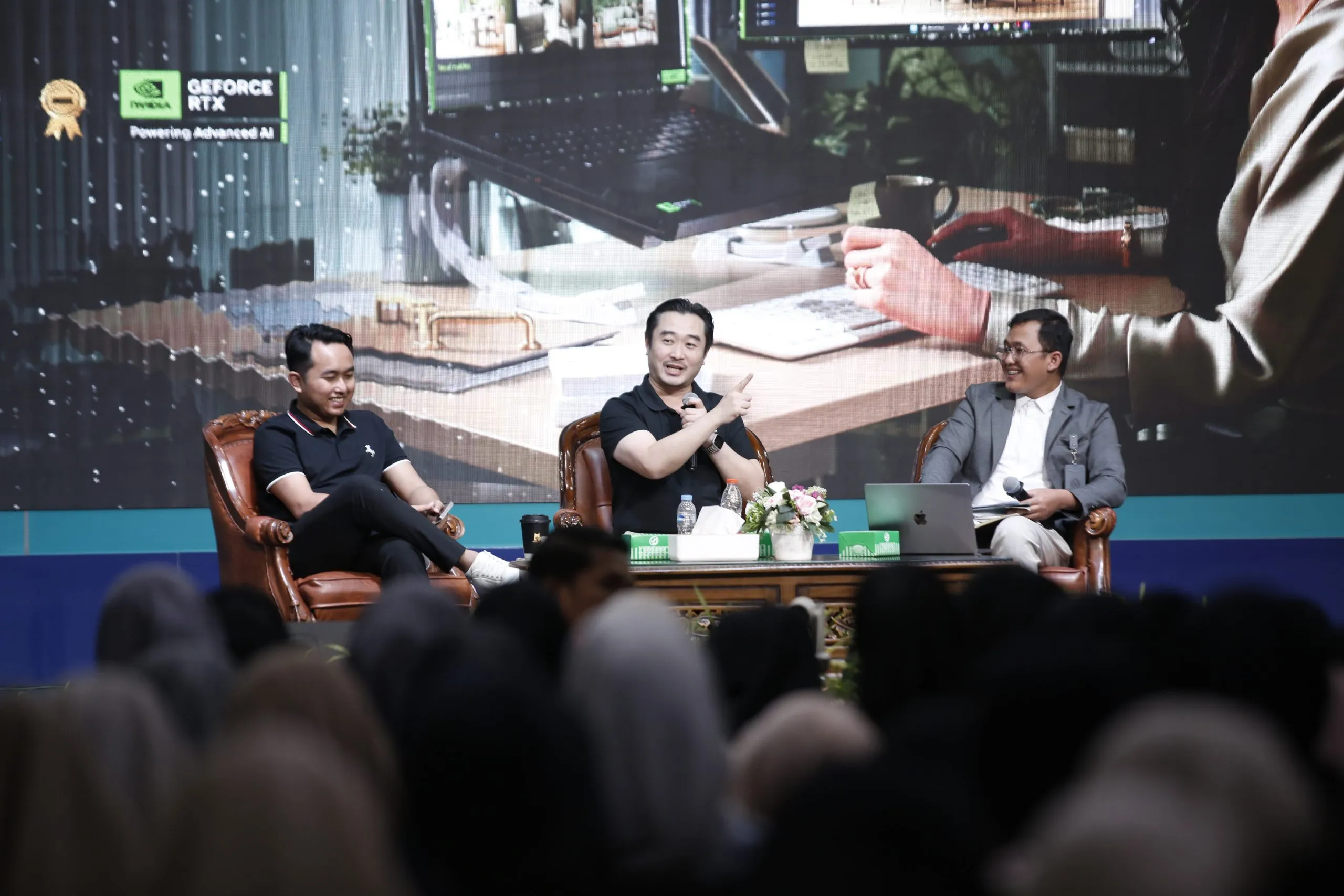
NVIDIA Corporation, in collaboration with the Faculty of Teacher Training and Education at the University of Muhammadiyah North Sumatra (FKIP UMSU), held a seminar titled “Digital Transformation in Education: Optimizing the Use of AI in Modern Learning Innovation” on Thursday (June 19) at the UMSU Auditorium, Jalan Muchtar Basri No. 3, Medan.
The event was officially opened by Vice Rector I, Prof. Dr. Muhammad Arifin, M.Hum, and featured speakers such as Adrian Lesmono, Consumer Business Leader at Nvidia, and Anjas Maradita, an AI practitioner and influencer with a background in mathematics education. More than 500 FKIP UMSU students and lecturers attended the seminar.
During the presentation session, moderated by the Head of UMSU Language Center, Muhammad Rafi’i, S.Pd., M.A., the first speaker, AI practitioner and influencer Anjas Maradita, shared his experiences and tips on utilizing AI for teachers and educators.
“I come from an education background, and I recommend that teachers start creating content to promote themselves. AI can help update teaching materials based on Bloom’s taxonomy, provide strong research-based content, and create more varied and engaging learning experiences,” he said.
 He also noted that in today’s tech era, creating websites and professional learning content has become much easier with the help of AI, though human skills are still needed to give precise instructions to these systems.
“AI can assist, but it won’t yield optimal results without the right input from us. As educators, it’s crucial to understand the mindset needed when using AI so that the content delivery becomes more engaging and professional,” he added.
Following that, Nvidia’s Consumer Business Leader Adrian Lesmono explained that AI is a powerful tool for the education sector but must be used wisely.
“Teachers will not be replaced by AI because human ethics cannot be replicated by machines,” Adrian emphasized.
He outlined three stages of AI utilization in education:
“There are three stages: shortcut seeker (for efficiency), tool master (for checking and brainstorming), and problem solver (for tackling issues). It’s time we view AI as a problem solver that can support research and learning,” he explained.

Adrian also stressed the importance of data security awareness when using AI.
“Use AI wisely. Don’t upload personal data like health or bank account info. For example, ChatGPT uses public data, but in the future, there will be chatbots using private data to avoid privacy and security concerns,” he warned.
 In his session, Adrian introduced Nvidia’s AI products such as Nvidia Broadcast, Studio Voice, ChatRTX, and AI Assistant, all designed to support content creators and “eduvators.”
Earlier, while opening the event, UMSU’s Vice Rector I highlighted the importance of ethical awareness in using artificial intelligence (AI), given its vast potential and challenges.
“All of this is based on IoT. AI is man-made, but after creation, it can sometimes surpass its creators. Abroad, there have been tests comparing humans and robots, and the results show that robots can perform accurately, precisely, and efficiently,” he noted.
According to him, the use of IT such as AI must be accompanied by ethical understanding to foster a sense of responsibility.
Meanwhile, the Dean of FKIP UMSU emphasized the significance of this event in enhancing technology-based learning quality.

“We hope that through this event, both students and lecturers can transition from conventional to more modern teaching and learning methods,” he said.
The seminar was interactive, featuring a Q&A session and discussions, and concluded with the presentation of souvenirs by UMSU Vice Rector I, Prof. Dr. Muhammad Arifin, M.Hum, to the speakers.
Through this seminar, FKIP UMSU hopes that its lecturers and students will be better prepared to face the ongoing digital transformation in education, by adopting AI as a strategic partner in the teaching and learning process.


