


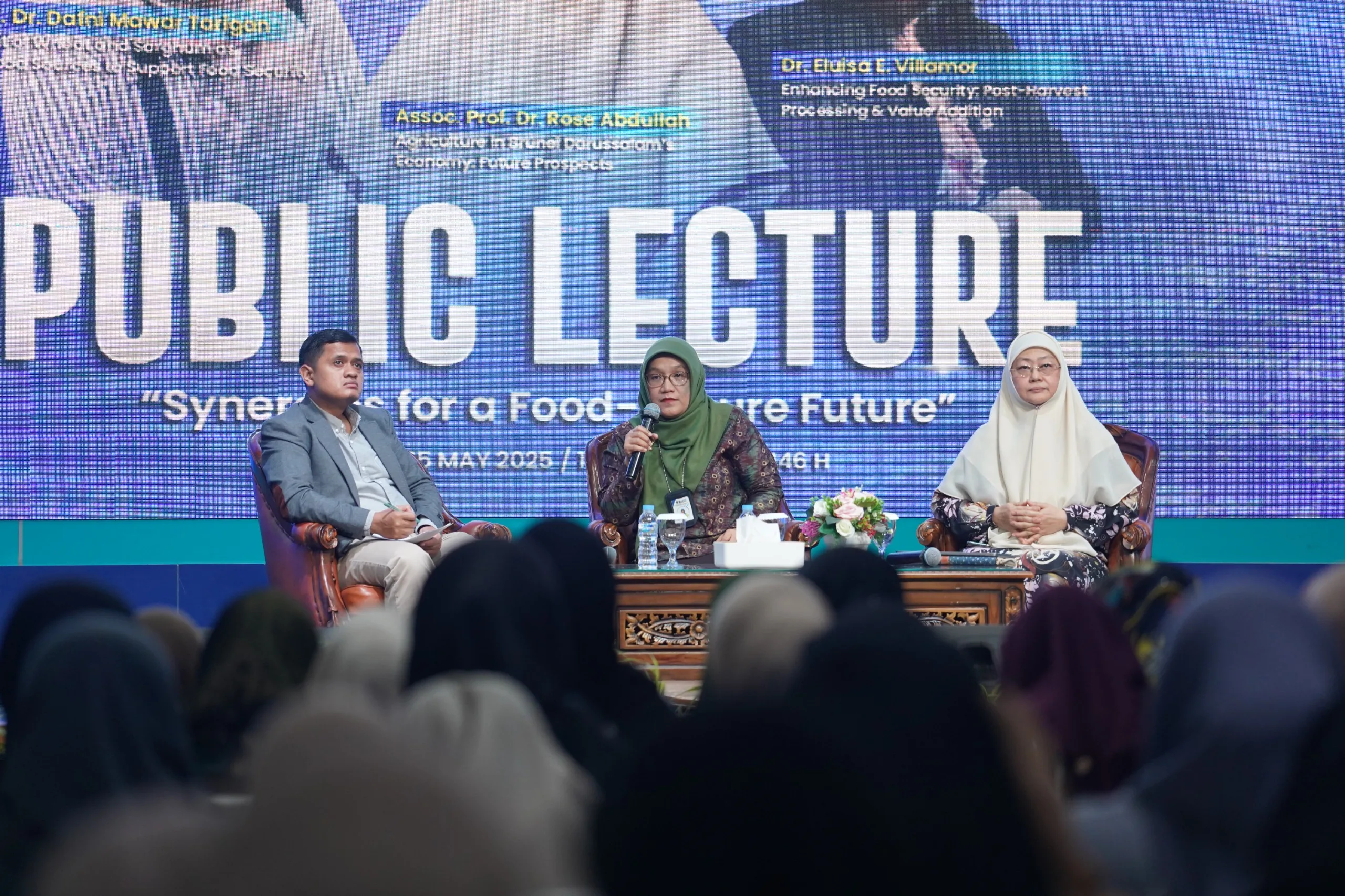
The University of Muhammadiyah North Sumatra (UMSU) successfully held an International Public Lecture titled “Synergy for a Food-Secure Future” on Thursday (May 15), conducted in a hybrid format and centered at the UMSU Auditorium, Jalan Muchtar Basri No. 3, Medan.
 This event was a collaboration between UMSU, Universiti Islam Sultan Sharif Ali (UNISSA) of Brunei Darussalam, and Iloilo State University of Fisheries Science and Technology (ISUFST) of the Philippines. It served as a strategic forum for academics and students from Indonesia, Brunei Darussalam, and the Philippines to discuss global issues related to food security and sustainable agriculture.
Moderated by UMSU Faculty of Agriculture lecturer and Secretary of the Institute for Research and Community Service (LPPM), Dr. Syaiful Amri Saragih, S.P., M.Sc., the session was more than a public lecture — it was a concrete example of international synergy to address global food challenges and support the achievement of the Sustainable Development Goals (SDGs), particularly Goal 2: Zero Hunger.
The first speaker, Associate Professor Dr. Rose Abdullah, Dean of the Faculty of Agriculture at UNISSA, delivered a presentation titled “Agriculture in Brunei Darussalam Economy: Future Prospect.” She highlighted that agriculture contributes only about 1.2% to Brunei’s GDP, and the country remains heavily reliant on imported food.
“Our local rice production only accounts for 8.2% of national consumption, meaning around 90% is still imported,” explained Dr. Rose.
She emphasized the need to develop agricultural technologies such as urban farming, greenhouses, high-quality crop varieties, and organic fertilizers to address Brunei’s acidic soil challenges.
“We aim to boost rice yields from 4–5 tons per hectare to 10 tons through soil engineering and advanced technology,” she added.
Dr. Rose also noted that the Brunei government provides subsidies for locally grown rice and encourages youth involvement in agriculture through various incentives and training programs.
 The second speaker, Associate Professor Dr. Dafni Mawar Tarigan, S.P., M.Si, Dean of UMSU’s Faculty of Agriculture, presented strategies for developing alternative crops to reduce Indonesia’s dependency on wheat imports. Her presentation, “Advancement of Wheat and Sorghum as Alternative Food Sources to Support Food Security,” underscored the significance of sorghum and locally-grown wheat.
“Indonesia imports over 12 million tons of wheat annually, nearly all from abroad. This presents a major challenge to our food sovereignty,” said Dr. Dafni.
She explained that sorghum offers many benefits: it is drought-tolerant, nutrient-rich, and entirely usable for food, animal feed, and bioenergy production.
Dr. Dafni also outlined the challenges in developing wheat and sorghum in Indonesia, including a lack of superior varieties, underdeveloped processing industries, and limited regulatory support.
“Our current focus is on research and sorghum breeding to identify varieties suitable for Indonesia’s agroecological conditions,” she said.
The third speaker, Dr. Eluisa E. Villamor from ISUFST, delivered a presentation titled “Enhancing Food Security Through Post-Harvest Processing and Value Addition.” She emphasized the importance of minimizing post-harvest losses and increasing the value of agricultural products.
“In developing countries, up to 30–40% of harvests are lost due to poor post-harvest handling. This is ironic given the global food crisis,” Dr. Eluisa remarked.
She introduced various post-harvest treatment methods such as cold storage, vacuum packaging, edible coating, and controlled atmosphere systems. Additionally, she discussed value-added processes including fortification, fermentation, and the processing of local foods.

“By adding value to agricultural products, we not only extend shelf life but also create export opportunities and increase farmers’ incomes,” she noted.
The discussion session was interactive, with enthusiastic participation from students across various faculties. One student, Wanda Ekmardana from the Faculty of Economics and Business, asked how to attract younger generations to pursue careers in agriculture.
In response, Dr. Rose and Dr. Eluisa stressed the importance of education, incentives, and the use of modern agricultural technology as key to engaging youth.
“The key lies in incentives, technology, and continuous training. We need to show that farming can be modern and profitable,” Dr. Rose emphasized.
Closing the event, Dr. Syaiful expressed hope that the lecture would serve as the beginning of broader international research collaboration in food security.
“UMSU is committed to being an impactful university. We continuously support innovative, sustainable, and applicable research to improve community welfare,” he concluded.


