


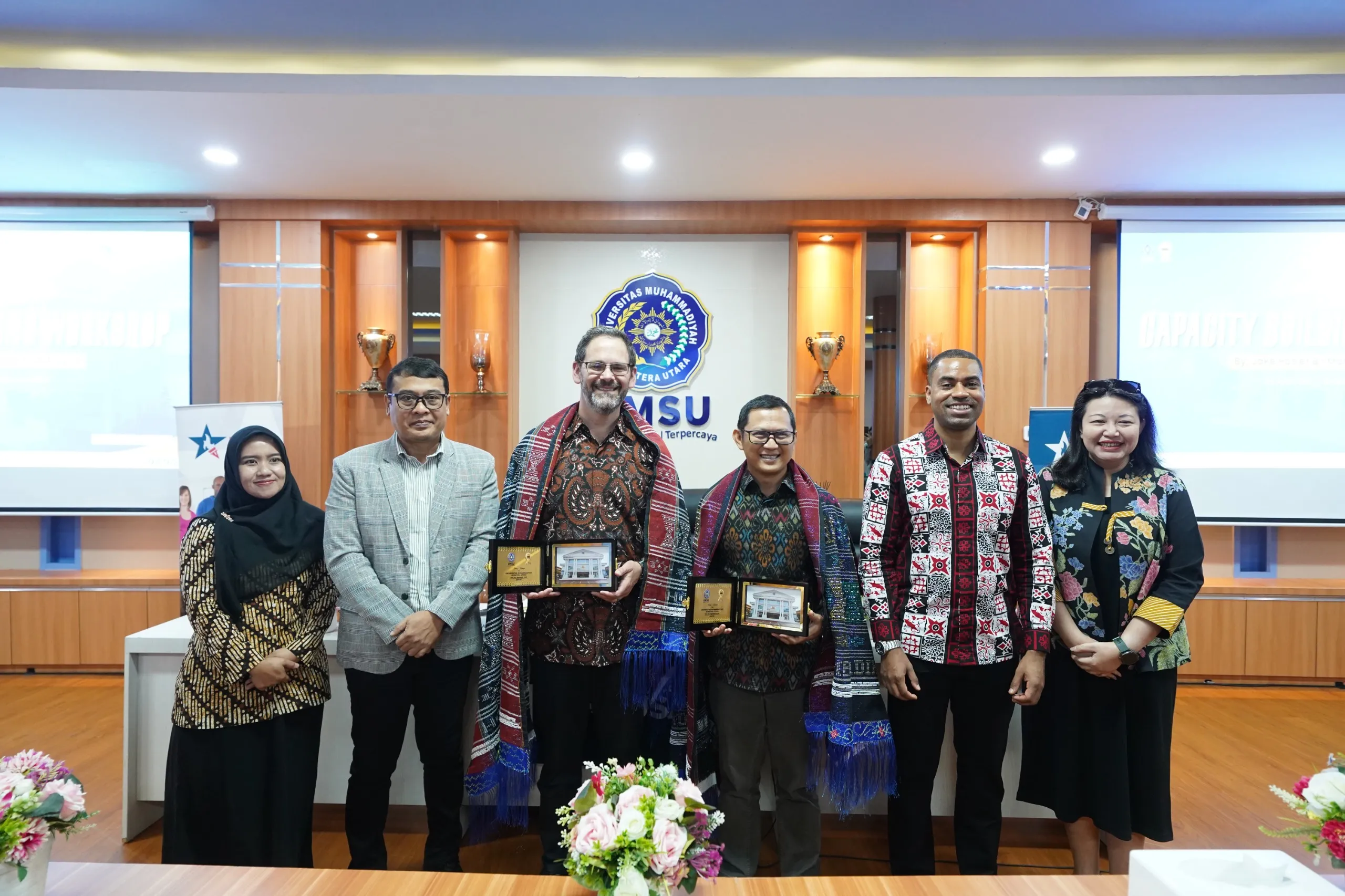
The University of Muhammadiyah Sumatera Utara (UMSU), in collaboration with the U.S. Consulate in Medan, held a Study Abroad Engagement Grant (SAEG) Capacity Building Workshop for Faculty Members to enhance academic internationalization strategies and explore opportunities for global collaboration. The event took place on Thursday (April 24) at the UMSU VIP Room, Jalan Muchtar Basri No.3, Medan.
The workshop was officially opened by UMSU Rector Prof. Dr. Agussani, MAP, represented by Vice Rector III Assoc. Prof. Dr. Rudianto, M.Si. Also in attendance was Joshua Gonzalez, Head of Public Affairs and Culture at the U.S. Consulate in Medan. The speakers included Mr. Jacob Hosier, Director of Access Programs, Continuing, and Professional Education at the University of California (UC) Davis, and Dr. I Made Andi Arsana, a lecturer in Geodesy at Universitas Gadjah Mada.
In his remarks, Joshua Gonzalez expressed appreciation for the ongoing partnership between UMSU and the U.S. Consulate.
“This isn’t our first collaboration. I deeply appreciate all the joint initiatives we’ve successfully undertaken. Today, we come together once again to pursue shared success in the future,” he said.
 Earlier, UMSU Rector expressed gratitude and reaffirmed the university’s commitment to supporting international engagement.
“We strongly support this collaboration as a means to elevate UMSU to the international stage. We hope to see this partnership continue to grow across various fields,” he stated.
Vice Rector III Dr. Rudianto also conveyed his appreciation for the presence of both local and international delegates and speakers.
“We are honored to welcome distinguished speakers from the United States and Indonesia. This event brings together representatives from all UMSU faculties and marks a key step in strengthening our university-wide internationalization strategy,” he said.
He encouraged participants to engage actively in discussions and apply the knowledge gained from the workshop.
During the talk show session, UC Davis’ Jacob Hosier shared insightful perspectives on the profile of American students studying abroad.
“Most are women over the age of 30, prefer short-term programs, and are drawn to countries that reflect their ancestral roots or offer unique cultural experiences,” he explained.
“According to 2021/2022 data, American students typically go to the UK, France, Italy, or South Korea. Why? Because they are interested in learning about the culture, language, and lifestyle—like South Korea with its K-pop phenomenon,” he added.
Hosier believes that Indonesia, particularly UMSU, has significant potential to attract American students through programs that highlight social sciences, humanities, and local culture.
“This cultural richness is a major strength for Indonesia. But it requires strategic promotion and sustained collaboration—something Australia has done very well,” he noted.
He also invited participants, including UMSU’s faculty leaders and institutional heads, to develop and propose programs that could appeal to American students and encourage them to study in North Sumatra.

In the next session, Dr. I Made Andi Arsana from UGM emphasized that academic internationalization must be built on the foundation of friendship.
“Networking can lead to either partnerships or dependency—it depends on how we build it. The key is to think of ourselves as coming from a great nation so we can engage with confidence on the global stage,” he said.

He also stressed the importance of understanding and promoting Indonesia’s identity before introducing the university.
“Is internationalization important? How do we go about it? When collaborating with top global institutions, we must not feel inferior,” he said.
According to Dr. Arsana, globalization brings both opportunities and challenges, which is why international academic programs must be established—to expose students to global experiences, even through hosting international speakers or facilitating student exchanges.
“The key is to understand the complexity of Indonesia, to be able to explain where it is, then where your region is, and only after that introduce your university,” he concluded.
This workshop was part of the Study Abroad Engagement Grant (SAEG) and is expected to open broader pathways for international collaboration between UMSU and institutions in the United States and beyond.


