


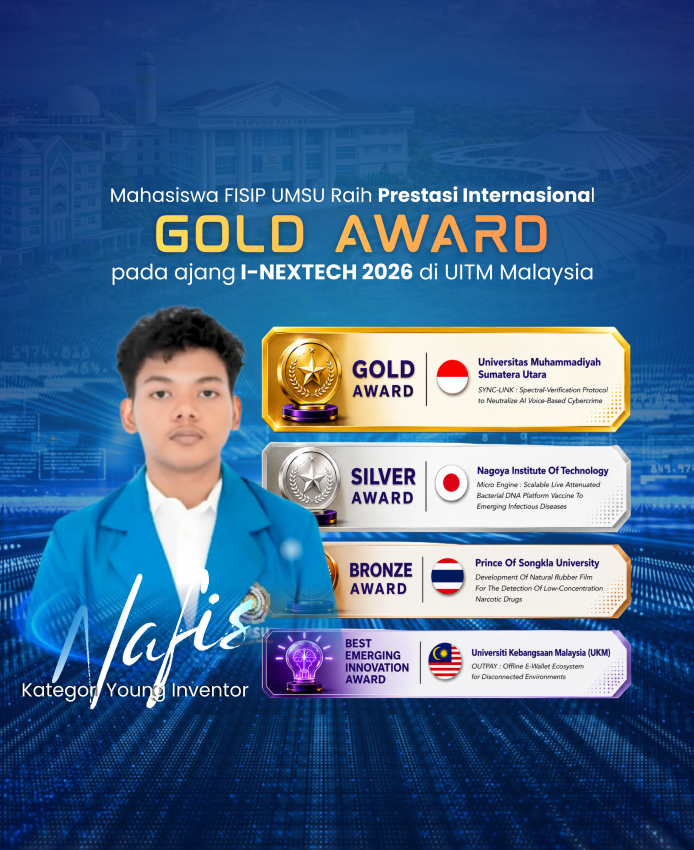
Muhammad Nafis, a student from the Faculty of Social and Political Sciences (FISIP) at Universitas Muhammadiyah Sumatera Utara (UMSU), won the Gold Award at the International Next-Generation Innovation and Technology Exposition (I-NEXTECH) 2026.
The competition was organized by Universiti Teknologi MARA (UiTM) Melaka Branch in collaboration with the Melaka State Ministry of Education, Malaysia. Held virtually, the event attracted 229 participants from Indonesia, Malaysia, Thailand, Sri Lanka, and Japan.
Nafis secured the prestigious award with his research paper and presentation titled “SYNC-LINK: Spectral-Verification Protocol to Neutralize AI Voice-Based Cybercrime,” outperforming competitors from Japan, Thailand, and Malaysia.
UMSU Rector Prof. Dr. Akrim, M.Pd, accompanied by Vice Rector III Dr. Rudianto, M.Si, congratulated Nafis on his outstanding achievement.
“Alhamdulillah, this is an achievement that deserves our full support and continued development. UMSU remains committed to encouraging students to excel, innovate, and compete on the international stage,” the Rector said.
He noted that Nafis’s research, which focuses on artificial intelligence and cybersecurity, aligns closely with UMSU’s vision of developing a digital campus. The project reflects the university’s commitment to fostering technological innovation and promoting the responsible use of AI among students.
According to the Rector, supporting students in achieving global recognition is a strategic step toward strengthening UMSU’s international reputation.
In addition to its students’ accomplishments, UMSU has earned numerous international recognitions, including FIBAA international accreditation, Malaysia Qualifications Agency (MQA) recognition, AppliedHE, the Times Higher Education Impact Rankings, and the World University Rankings.
Meanwhile, Nafis expressed his gratitude and excitement over receiving the award.
“Alhamdulillah, I am truly grateful. I never expected to win. My initial goal was simply to learn and gain experience by participating in an international competition,” he said.
He hopes that his SYNC-LINK Protocol, which integrates concepts from Communication Studies and Cybersecurity, can contribute to strengthening digital security and combating AI-driven cybercrime.
Nafis also shared that he spent three months preparing for the competition. His work began with identifying urgent global cybersecurity issues, followed by extensive research and the careful development of an innovative solution.


