


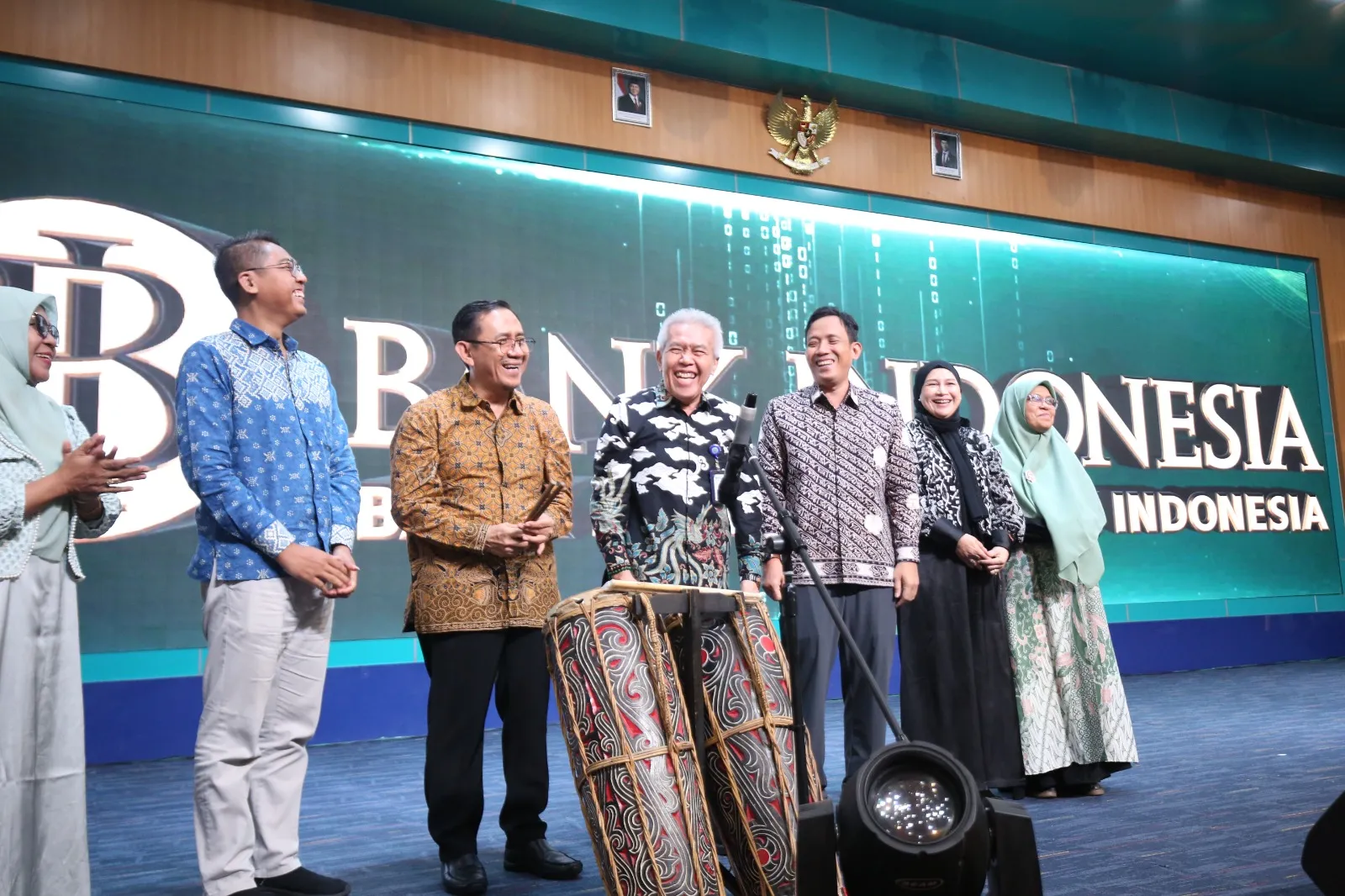
Bank Indonesia North Sumatra, in collaboration with the Halal Center (HC) of Universitas Muhammadiyah Sumatera Utara (UMSU), organized Semesta Fest 2025 on Thursday (April 30) at the UMSU Auditorium, Jalan Muchtar Basri No. 3, Medan.
 The event featured a National Seminar on Modest Movement & Halalpreneurship with the theme “Transforming the Sharia Economy for Today’s UMKM.” This initiative is part of the Halal Center’s efforts to raise public awareness on halal issues—not just in terms of certification, but also in ensuring halal processes throughout production and distribution.
The event commenced with the ceremonial launch of the “Safe and Healthy Halal Culinary Zone,” marked by a traditional percussion performance using a pair of teganing drums, played by Deputy Director of Bank Indonesia North Sumatra, Dr. H. Suryono, S.E., M.M., and UMSU Rector, Prof. Dr. Agussani, M.AP, represented by Vice Rector I, Prof. Dr. Muhammad Arifin.
Dr. H. Suryono expressed appreciation for the successful organization of Semesta Fest 2025 through this collaborative effort between Bank Indonesia and UMSU.
“Collaboration is key to strengthening each other. As the country with the world’s largest Muslim population, halal lifestyle issues deserve serious attention,” he stated.
Speaking on the development of the sharia economy, Suryono outlined several challenges, including unequal access to sharia financing, limited halal certification among UMKM, and the need to improve both halal and sharia financial literacy.
“UMSU, as a Muhammadiyah-affiliated higher education institution, is expected to play an active role in addressing these challenges,” he added.
Dr. Suryono also highlighted another major challenge facing the Muslim community: the digital capability of UMKM. He emphasized that digitalization is a powerful force that can rapidly accelerate growth. The fast pace of IT development now enables UMKM products to be marketed without borders. “We must closely observe regulations and government incentives—Bank Indonesia included,” he noted.
Meanwhile, UMSU Vice Rector I, Prof. Dr. Muhammad Arifin, S.H., M.Hum., in his opening remarks, remarked that the concept of halal has evolved beyond just food and beverages. It now encompasses halalpreneurship, which relates to broader lifestyle aspects.
“In Islam, halal not only refers to the substance but also includes the entire process—how it’s produced and how it’s distributed,” he explained.
Prof. Arifin expressed his optimism about the increasing public awareness of halal in daily life. Today, halal is no longer exclusive to Muslims—it’s a universal concept for all humanity, as reflected in Surah Al-Baqarah.

“This is why the halal concept has gone global and continues to gain traction in many countries,” he emphasized.
The seminar, attended by hundreds of UMSU students from various study programs, featured three speakers:
-
Muhammad Arif, S.E., M.M. (Management Lecturer, FEB, and Halal Center Committee Member)
-
Ragil Misas Fuad (Economist, Department of Islamic Economics and Finance, Bank Indonesia)
-
Sofya Moureen (Owner of Mouca & Moureen, a Modest Fashion UMKM)
The session was moderated by Yusriati, S.S., M.Hum. (Lecturer at the Faculty of Education and Halal Center Committee Member).


