


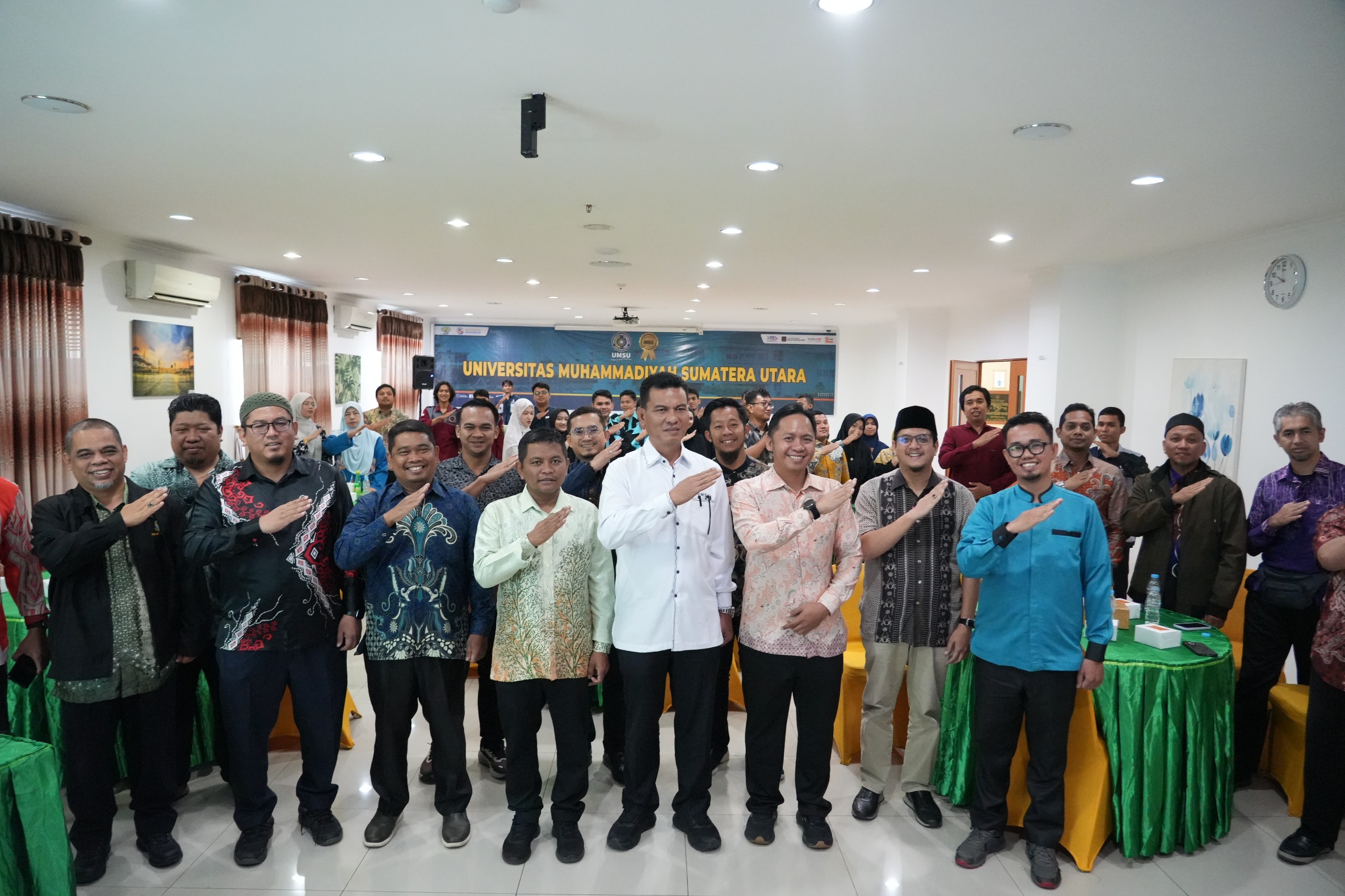
The Astronomy Observatory of Universitas Muhammadiyah Sumatera Utara (OIF UMSU), in collaboration with the Malaysian Association of Shariah Astronomers (Persatuan Juru Falak Syarie, JUFAS), held the International Islamic Astronomy Colloquium on Tuesday (September 8). The event was officially opened by UMSU Rector Prof. Dr. Akrim, M.Pd., represented by Vice Rector for Student Affairs and Alumni Assoc. Prof. Dr. Faisal, S.H., M.Hum. It took place at the Graduate School Auditorium on Jalan Denai, Medan, North Sumatra.
 Attendees included Muhammad Hidayat, Head of the Islamic Astronomy Study Program at UMSU’s Faculty of Islamic Studies; Associate Prof. Dr. Mohd Saiful Anwar bin Mohd Nawawi, Head of the JUFAS delegation and representative of the Academy of Islamic Studies at Universiti Malaya, Malaysia; and Assoc. Prof. Dr. Arwin Juli Rakhmadi Butar-Butar, Head of OIF UMSU.
Representing the Rector at the opening ceremony, Dr. Faisal expressed his appreciation for the international astronomy seminar organized by OIF UMSU and JUFAS Malaysia. He expressed hope that the work of OIF UMSU and the Islamic Astronomy Study Program would help advance the development of Islamic astronomy in Indonesia, particularly in North Sumatra.
“UMSU provides extensive facilities to support this study program. Those interested in astronomy are welcome to join the Faculty of Islamic Studies, which remains open to new students,” Dr. Faisal said.
The international event served as an academic forum bringing together experts, academics, and Islamic astronomy practitioners from Indonesia and Malaysia to exchange knowledge, experiences, and the latest developments in research and scholarship in Islamic astronomy, known locally as ilmu falak.
Meanwhile, JUFAS Malaysia Chair Dr. Mohd Saiful Anwar praised OIF UMSU’s progress in advancing Islamic astronomy. He noted that the delegation had gained valuable insights to share and apply in Malaysia.
A similar view was expressed by OIF UMSU Head Dr. Arwin Juli Rakhmadi Butar-Butar. He highlighted the rich astronomical heritage shared by the Malay world, much of which remains unexplored. He hoped that collaboration among Malay-world Islamic astronomy experts would help document and promote this heritage through academic studies, research, seminars, and publications.
The colloquium addressed a range of current topics in Islamic astronomy, including qibla direction determination by JUFAS Penang, official crescent moon observations at Baitul Hilal in Perak, solar eclipse phenomena from 2026 to 2028, and integrated modeling of Islamic astronomy using the Rubu‘ al-Mujayyab, a traditional astronomical instrument.
These topics demonstrated the breadth of Islamic astronomy, spanning qibla direction determination, crescent moon observation, astronomical phenomena, and the use of traditional instruments in the advancement of scientific knowledge.
The International Islamic Astronomy Colloquium also marked an important opportunity to strengthen academic and professional ties between Islamic astronomy practitioners in Malaysia and Indonesia. The exchange of experiences in observation practices, research, astronomical instruments, and the development of the discipline in both countries is expected to open up broader opportunities for future collaboration.

Through this forum, OIF UMSU and the Islamic Astronomy Study Program at UMSU’s Faculty of Islamic Studies continue to strengthen international networks in Islamic astronomy. Malaysia and Indonesia share not only the same skies but also significant opportunities to advance the field together.
The colloquium represents a step toward broadening perspectives, exchanging ideas, and building partnerships to better understand celestial phenomena through scientific inquiry.
The international seminar concluded with a tour of OIF UMSU’s facilities on the seventh floor of UMSU’s Graduate School building. At the OIF UMSU Planetarium, members of the JUFAS Malaysia delegation learned about the observatory’s facilities and resources.
Several Islamic astronomy experts from JUFAS Malaysia also attended, including Muhammad Haniff bin Baderun, a member of JUFAS Malaysia’s Executive Committee; Mohamad Faizal bin Jani, JUFAS Commissioner for Perak and a member of its Executive Committee; and Awangku Bolkhizan bin Awang Ahmad Thani, Assistant Mufti in the Astronomy and Information Resources Division of the Negeri Sembilan State Mufti Department, Malaysia.


