


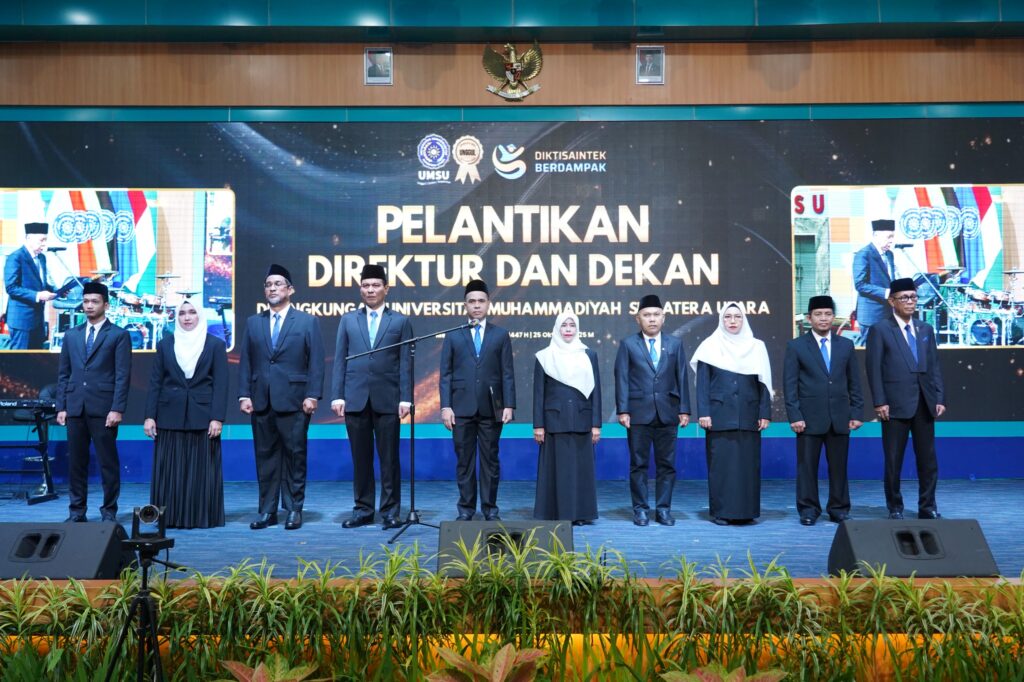
 The Rector of Universitas Muhammadiyah Sumatera Utara (UMSU), Prof. Dr. Agussani, MAP, inaugurated nine newly appointed deans and the director of the graduate school for the 2025–2029 term. The ceremony was attended by Indonesia’s Deputy Minister of Education, Culture, Research, and Technology (Kemendiktisaintek), Prof. Dr. Fauzan, M.Pd. The inauguration took place on Saturday morning (25/10) at the UMSU Auditorium on Jalan Muchtar Basri No. 3, Medan.
The ceremony began with the oath of office, followed by the inauguration of:
– Prof. Dr. Triono Eddy, S.H., M.Hum. as Director of the Graduate School
– Dr. Zailani, M.A. as Dean of the Faculty of Islamic Studies, replacing Dr. Muhammad Qorib, MA
– Dra. Syamsuyurnita, M.Pd. (FKIP)
– Dr. Arifin Saleh, S.Sos., MSP. (FISIP)
– Prof. Dr. Ir. Wan Arfiani Barus, M.P. replacing Dr. Dafni Mawar Tarigan (Faculty of Agriculture)
– Dr. Radiman, S.E., M.Si. replacing Dr. Januri, SE, Ak. (Faculty of Economics and Business)
– Dr. Faisal, S.H., M.Hum. (Faculty of Law)
– Ir. Ade Faisal, S.T., M.Sc., Ph.D. replacing Dr. Munawar Alfansuri, ST, MT (Faculty of Engineering)
– dr. Siti Masliana Siregar, Sp.THT-KL., Subsp.Rino(K). as Dean of the Faculty of Medicine and Health Sciences
– Dr. Al-Khowarizmi, S.Kom., M.Kom. as Dean of the Faculty of Computer Science and Information Technology
The inauguration was opened by the reading of the Rector’s Decree by Vice Rector for Finance and Human Resources, Prof. Dr. Akrim, M.Pd, followed by a handover ceremony from outgoing deans to their successors.
During the event, Deputy Minister Prof. Dr. Fauzan, M.Pd. extended his congratulations to the newly appointed deans and graduate school director, emphasizing the weight of leadership responsibilities in higher education.
“Leadership transitions are inevitable, but they come with significant consequences. Every transition demands responsibility and the determination to achieve better outcomes,” he stated.
He referenced the ‘One Percent Rule’, explaining that in any organization, only one percent serve as leaders, nine percent as critics, and the remaining ninety percent as beneficiaries of leadership.
“If you aim to please everyone, don’t become a leader—be a comedian. A leader must be ready to face criticism, because criticism helps us grow and improve,” he remarked.
He also highlighted the importance of empathy in leadership.

“Being a leader isn’t about ‘me,’ but ‘us.’ A good leader must be able to see, feel, and understand the needs of their environment,” he emphasized.
Prof. Fauzan further addressed the challenges faced by higher education in the digital generation. Today’s students, he said, have short attention spans and prefer shortcuts, requiring educators to adapt their teaching methods or risk being left behind.
“Surveys show that parents send their children to university hoping they will secure good jobs. The question is: are our programs aligned with that expectation? Universities must understand the needs of society. UMSU must be able to respond to societal and workforce demands,” he said.

He also underscored the importance of creating impact-driven campuses, stating that universities should not only serve as learning centers but must produce graduates who are relevant to community needs.
 “If this is the expectation, then universities must be designed to create impact. This is not easy, as it requires a shift from viewing universities merely as learning spaces. This mindset must be embraced by university leaders,” he added.
Prof. Fauzan encouraged UMSU to continue innovating and collaborating with government programs in higher education.
“A good UMSU is one that can address challenges in its surroundings. Universities must not only be places of learning but agents of social change,” he concluded.
Earlier, UMSU Rector Prof. Agussani, filled with emotion, shared that leadership transitions at UMSU are part of a well-established regeneration process aligned with Muhammadiyah principles.
“Thank you to all deans who have worked extraordinarily with UMSU. At the end of their terms, the Faculties of Economics and Business and Islamic Studies successfully achieved international accreditation from FIBAA. I hope the new leadership will continue fostering innovation, achievement, and unity,” he said.
He noted that despite intense competition among universities and a national decline in the Gross Enrollment Ratio (APK), UMSU continues to earn strong public trust.
“Even though national university enrollment is decreasing, Alhamdulillah, UMSU has received 4,600 new students this year,” he reported.

The Rector also highlighted several university achievements, including 18 international students from countries such as the UK, USA, Nigeria, and Yemen, as well as accomplishments in the PKM and P2MW programs.
“This shows that UMSU continues to earn public trust amid increasing competition,” he added.
Regarding the upcoming Muhammadiyah Congress 2027 in North Sumatra, Prof. Agussani reported to the Deputy Minister that construction of the congress venue has reached over 28% progress.
Chairman of the Muhammadiyah Regional Board of North Sumatra (PWM Sumut), Prof. Dr. H. Hasyimsyah Nasution, MA, reminded the newly appointed leaders that their roles bear great responsibility.
“Leadership is not merely authority, but the mandate to help many people. Strengthen yourselves—personally and collectively—so that this mandate brings meaningful benefits,” he urged.
The inauguration was attended by the UMSU Board of Trustees Chairman Dr. Bahril Datuk, S.E., M.M., representatives from Muhammadiyah organizations, regional leaders, healthcare partners, university rectors, public officials, and families of the newly appointed deans and directors.


